Seems like yesterday that this pipeline was built, and already they are expanding it, typical bad planning, but hey, only the environment suffers from all this activity, right?
Local paper article: FortisBC seeks environmental approval for twinning project
The Environmental Assesment Office : Eagle Mountain - Woodfibre Gas Pipeline Project
Where you can find the numerous documents, and open house information, the usual,,,
I am sure that they will leave the area in worse shape this time than last, the land is still attempting to heal itself along the Right of Way from the last onslaught of activity.
UPDATE: So
the truth about this matter is slowly being made public. The pipeline
twinning is to go to the old Woodfibre site, near Squamish, where the gas will be
compressed, probably by burning a portion of the gas, and put onto ships for
Singapore. Pressure for quick LNG approvals may trigger backlash
Public comments (PDF)
Sounds like a done deal, Squamish will have to learn to deal with the noise from the compressors, which can be quite scary sounding sometimes, and also the huge amount of gas pollution from them. I loved the vague concept that the proponent will look into using electricity to power the compressors; something that has not been done yet in western Canada, and probably never will be. It would be slightly better for the environment though.
Am I alone in noticing how vague the proponents prospectus about this matter is? But hey our Premier apparently embraces the gas industry, maybe she has inhaled a little too much H2S?
A few of the many groups who are opposed to many aspects of the proposal:
Future of Howe Sound society ( FHSS )
Squamish Streamkeepers
Sea to Sky clean air society
Way back in 1989 there was the, Coquitlam Watershed Pipeline Inquiry ( 1989 ) (102Mb, PDF)
[ Warning this file can be glacial in downloading. ]

Opinions expressed on this blog are my own, and not officially Burke Mountain Naturalists
Friday, November 15, 2013

Monday, October 28, 2013
NO to coal
No rest for the wicked they say, so to that end a few merry souls marched off to New West to host Take Back Our Port rally on Sunday Beautiful weather too.
Some background about the numerous issues facing the environment: FRIDAY FEATURE: Port giant needs to step away from enviro table: Biologist, mayor;
Potential coal export expansion, aviation fuel delivery plan, tunnel replacement leads to question; how much power does Port Metro Vancouver have?
Numerous issues being debated as usual, never just a simple one task to be dealt with, but all with a common thread of potential damage to the environment we cherish.
A few of the numerous groups involved: Voters Taking Action on Climate Change --- Wilderness Committee --- Dogwood Initiative --- BMN --- Texada Stickleback Group --- Communitiesandcoal. . . .
Some of the television media coverage: CBC: Hundreds protest Fraser River coal facility
GLOBAL: Environmental groups, concerned residents, say ‘no to US coal’ and Surrey port expansion
Some pictures:


Some background about the numerous issues facing the environment: FRIDAY FEATURE: Port giant needs to step away from enviro table: Biologist, mayor;
Potential coal export expansion, aviation fuel delivery plan, tunnel replacement leads to question; how much power does Port Metro Vancouver have?
Numerous issues being debated as usual, never just a simple one task to be dealt with, but all with a common thread of potential damage to the environment we cherish.
A few of the numerous groups involved: Voters Taking Action on Climate Change --- Wilderness Committee --- Dogwood Initiative --- BMN --- Texada Stickleback Group --- Communitiesandcoal. . . .
Some of the television media coverage: CBC: Hundreds protest Fraser River coal facility
GLOBAL: Environmental groups, concerned residents, say ‘no to US coal’ and Surrey port expansion
Some pictures:

The Texada Stickleback under threat by the proposed expansion, and change of use of a LaFarge Canada Aggregate quarry on Texada Island to store the dirty coal.
( Larger Pic )
( Larger Pic )

Fiberglass Killer Whale, chasing the paper mache Stickleback.
( Larger Pic )
( Larger Pic )

Giant paper mache Sandpiper
( Larger Pic )

Part of the BMN contingent.
( Larger Pic )

Overlooking part of the crowd.
( Larger Pic )
( Larger Pic )
Monday, September 23, 2013
Oil and the Second Narrows bridge
The Second Narrows bridge (the railway bridge) has been replaced a few times through the years and has always been a chokepoint in Burrard Inlet that many large ships have had problems navigating through.
I can remember this event well The 1979 collison from a Oil tanker (scroll down in the story ) with the span, which put it out of service for many months.
This was a very close call in 1979 with the MV Japan Erika, that many people have totally forgoten about (I have some pictures taken from the water of this accident, I will have a look for them soon, and post some of them up. Rare close up views).
Some earlier accidents, and by no means complete either.


Nothing much has changed here, the bridge was fixed from the 1979 incident, studies were generated as usual but not much done, other than tugs now assist ships through the area, BUT the ships, especially when combined with the weather, tides, etc, are far more powerful than the tugs can sometimes control.
( personal experience )
Groups like Burke Mountain Naturalists (BMN), Raincoast Conservation Foundation, (RCF),
Conversations for Responsible Economic Development, (CRED) and Pipe-up
among many others are spearheading the opposition to expansion of this type of traffic through the Port of Vancouver. Contact the groups and also your local M.P., M.L.A. and local politicians and voice your concerns.
UPDATE: As promised above, a few pictures of the 1979 incident, these have never been seen in public.


Forest Ethics has created a website to track the local oil tanker traffic
A good way to look at most of the larger vessels transiting the area is to look at Marinetraffic com
which is a better way really to look at the shipping traffic since it gives a better sense of the scale of it, and the traffic congestion in the harbour. Remember there is much more work boat, small boat traffic than the larger ships.
I can remember this event well The 1979 collison from a Oil tanker (scroll down in the story ) with the span, which put it out of service for many months.
This was a very close call in 1979 with the MV Japan Erika, that many people have totally forgoten about (I have some pictures taken from the water of this accident, I will have a look for them soon, and post some of them up. Rare close up views).
Some earlier accidents, and by no means complete either.

Damage to Second Narrows bridge by the Calmar Shipping Lines, "Losmar".
Photo: Leonard Frank, 3 May 1930. Van. Library 12357
Photo: Leonard Frank, 3 May 1930. Van. Library 12357

Damage to Second Narrows bridge by the Calmar Shipping Lines, "Losmar".
Photo: Leonard Frank, 3 May 1930. Van. Library 12358
Photo: Leonard Frank, 3 May 1930. Van. Library 12358

S.S. "Losmar", after knocking down a span of the Second Narrows bridge. April 1928.
Photo: donated by C.M. Rolston. Van. Archives A24374

Accident "Norwich City" collision with Second Narrows bridge 23 April 1928
Van. Archives A00490

Accident "Pacific Gatherer" collision with Second Narrows bridge. Tug "Lorne" standing by.
Photo: Stuart Thomson 19 September 1930. Van Archives A00818

Accident "Pacific Gatherer" collision with Second Narrows bridge, 19 September 1930.
Tug "Lorne" standing by. Photo: Stuart Thomson. Van Archives A00820

Aerial view of Burrard Inlet. ca. 1942-1945. Cropped slightly, note how the inlet narrows here, a perfect place for a bridge, the Iron Workers Memorial bridge will not be finished until 1960.
Photo: R.C.A.F. Van. Archives A66600

Province Newspaper, Second Narrows bridges. Van Library 39713
Nothing much has changed here, the bridge was fixed from the 1979 incident, studies were generated as usual but not much done, other than tugs now assist ships through the area, BUT the ships, especially when combined with the weather, tides, etc, are far more powerful than the tugs can sometimes control.
( personal experience )
Groups like Burke Mountain Naturalists (BMN), Raincoast Conservation Foundation, (RCF),
Conversations for Responsible Economic Development, (CRED) and Pipe-up
among many others are spearheading the opposition to expansion of this type of traffic through the Port of Vancouver. Contact the groups and also your local M.P., M.L.A. and local politicians and voice your concerns.
UPDATE: As promised above, a few pictures of the 1979 incident, these have never been seen in public.

Eastern side of Second Narrows bridge, 1979 (Flickr pic)

Western side of Second Narrows bridge, 1979 (Flickr pic)
 Southern pier of the Second Narrows train bridge, 1979 (Flickr pic)
Northern pier of the second Narrows train bridge, 1979 (Flickr pic)
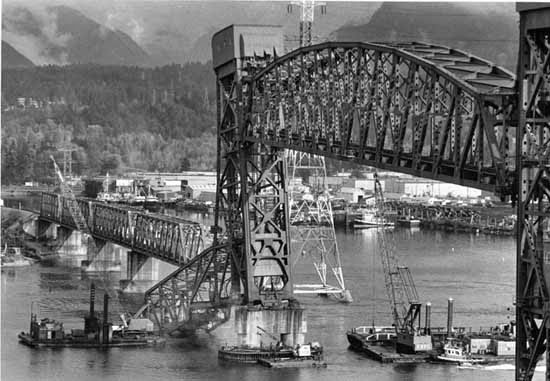 Marine cranes at work… Repairs to the heavily damaged Canadian National Railway bridge across Burrard Inlet resumed Monday when workers returned to their jobs after a work stoppage Sunday. Twenty members of International Association of Bridge, Structural and Ornamental Iron Workers refused to work when they discovered a shim under the northeast leg had come free.
The problem was corrected and the bridge declared safe for continued repair.
The span was knocked out two weeks ago by a Japanese freighter.
photo: Peter Battistoni; Columbian Photo. Record ID 67030
The problem was corrected and the bridge declared safe for continued repair.
The span was knocked out two weeks ago by a Japanese freighter.
photo: Peter Battistoni; Columbian Photo. Record ID 67030
Forest Ethics has created a website to track the local oil tanker traffic
A good way to look at most of the larger vessels transiting the area is to look at Marinetraffic com
which is a better way really to look at the shipping traffic since it gives a better sense of the scale of it, and the traffic congestion in the harbour. Remember there is much more work boat, small boat traffic than the larger ships.
Subscribe to:
Posts (Atom)